Why Sous-Vide Cooking Is Better for Your Dog

Why Sous-Vide Cooking Is Better for Your Dog
When people talk about fresh dog food, the conversation usually starts with ingredients.
What’s discussed far less — and often matters just as much — is how that food is cooked.
Cooking method affects nutrient structure, digestibility, moisture, and food safety. In other words, it shapes how food behaves inside the body, not just how it appears on a label.
Sous-vide cooking takes a fundamentally different approach from conventional high-heat methods — and for dogs, that difference is meaningful when applied correctly.
What Sous-Vide Cooking Actually Is
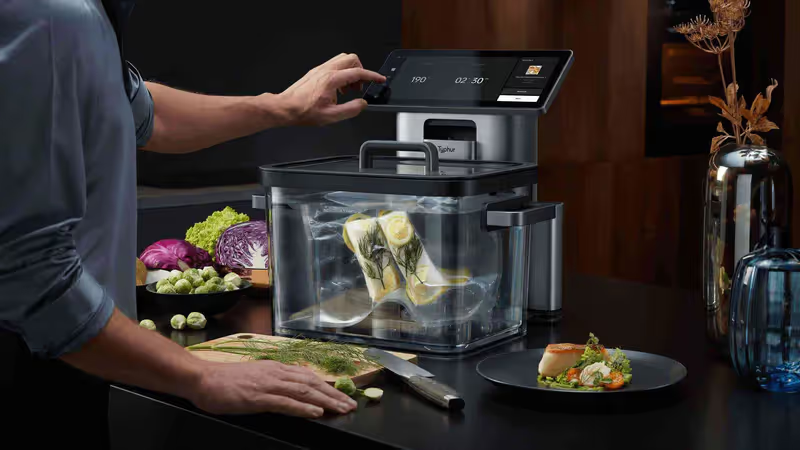
Sous-vide is a cooking method in which food is sealed and cooked at precisely controlled, low temperatures for extended periods of time.
Instead of relying on aggressive heat, pressure, or dehydration, sous-vide depends on:
- Temperature precision
- Gentle heat transfer
- Moisture retention
In professional kitchens, sous-vide is used because it allows repeatable, controlled results. When applied to dog food, those same principles influence digestibility, nutrient preservation, and consistency.
Sous-vide is not raw — but it also avoids the extremes of high-heat processing.
Sous-Vide Is a Technique — Not a Luxury Label
It’s important to clarify something that often gets blurred in marketing language:
Sous-vide is a cooking technique — not a quality grade.
It does not automatically mean:
- Gourmet
- Restaurant-level
- Premium
- Michelin
- Superior by default
In professional culinary practice, sous-vide is simply one tool among many. It’s used when temperature control and moisture retention are beneficial — not as a status marker.
A poorly designed recipe cooked sous-vide is still a poorly designed recipe.
A nutritionally imbalanced formula cooked sous-vide is still nutritionally imbalanced.
Technique does not replace formulation.
What matters is:
- Ingredient quality
- Nutritional balance
- Temperature accuracy
- Food safety controls
- Portion logic
Sous-vide supports these goals — it does not guarantee them.
Why High Heat Changes Food More Than Most People Realize
Traditional cooking methods — including extrusion, baking, roasting, and boiling — rely on high temperatures to achieve speed and scale.
High heat can:
- Alter protein structure aggressively
- Oxidize fats
- Degrade heat-sensitive vitamins
- Remove intrinsic moisture
These changes don’t automatically make food unsafe, but they do change how nutrients are presented to the digestive system.
Nutrition isn’t just about what nutrients are present.
It’s about how accessible those nutrients are once consumed.
Calories and ingredient lists alone can’t answer that.
The Science Behind Gentle Cooking and Protein Structure
Proteins are complex three-dimensional structures that change shape when exposed to heat — a process known as denaturation.
Some denaturation is necessary for digestion. The issue is degree and speed.
At very high temperatures, proteins can:
- Unfold too aggressively
- Form tighter aggregates
- Become less accessible to digestive enzymes
Lower, controlled temperatures — like those used in sous-vide cooking — allow proteins to denature more gradually, often preserving structures that enzymes can break down more efficiently.
Across food science and animal nutrition research, gentler heat treatment has been associated with:
- Improved protein digestibility
- Reduced formation of heat-related degradation compounds
- More predictable nutrient availability
This doesn’t mean food should be raw.
It means how heat is applied matters.
Sous-Vide and Nutrient Preservation
Because sous-vide cooking operates at lower, tightly controlled temperatures, it helps preserve:
- Amino acid integrity
- Natural fats in a less oxidized state
- Water-soluble vitamins
- Intrinsic moisture within food
High-heat processing often requires nutrients to be added back after cooking. Gentle cooking reduces the degree of loss in the first place.
For dogs, whose digestive systems evolved around moist, animal-based foods, this difference is physiologically relevant.
Preservation is not about presentation — it’s about biological accessibility.
Moisture, Enzymes, and Digestive Efficiency
Digestion is an enzyme-driven process — and enzymes function best in hydrated environments.
Dry foods require the stomach to rehydrate them before digestion can proceed efficiently. Moisture-rich foods support:
- Faster enzymatic interaction
- Improved gastric processing
- Smoother nutrient absorption
Sous-vide cooking retains moisture instead of driving it off through evaporation or dehydration. That retained moisture influences how nutrients are accessed after ingestion.
For dogs, hydration from food is functional — not incidental.
Digestibility: Where Cooking Method Shows Up Most Clearly
Digestibility reflects how effectively the body can break food down and absorb nutrients.
Aggressive heat can:
- Reduce enzymatic accessibility
- Increase oxidation byproducts
- Increase digestive workload
Sous-vide helps mitigate these effects by:
- Preserving more enzyme-accessible protein structures
- Maintaining moisture
- Limiting heat-induced degradation compounds
For many dogs, this can show up as:
- More consistent stool quality
- Better food tolerance
- More efficient nutrient utilization
Not because the ingredient list changed — but because processing conditions did.
Food Safety Without Overprocessing
Fresh food does not need to be either raw or heavily overcooked to be safe.
Sous-vide allows food to be held at defined temperatures for defined times — which can reduce pathogenic risk while avoiding excessive nutrient damage.
This balance between safety and integrity is why controlled low-temperature cooking is widely used in regulated food environments.
How This Fits Into The Wolfery’s Approach
At The Wolfery, sous-vide is not used as a marketing label.
It’s used as a precision cooking tool.
Our priority is:
- Gentle transformation rather than aggressive processing
- Digestibility over buzzwords
- Precision over theatrics
Technique serves nutrition — not the other way around.
The Bigger Picture
Fresh food is not defined by appearance or terminology.
It’s defined by how it functions biologically.
Cooking method matters.
Temperature matters.
Moisture matters.
Sous-vide — when used correctly — supports these fundamentals.
That’s its value.
Written by Chef Joseph Ruby, Founder & Chef of The Wolfery Company