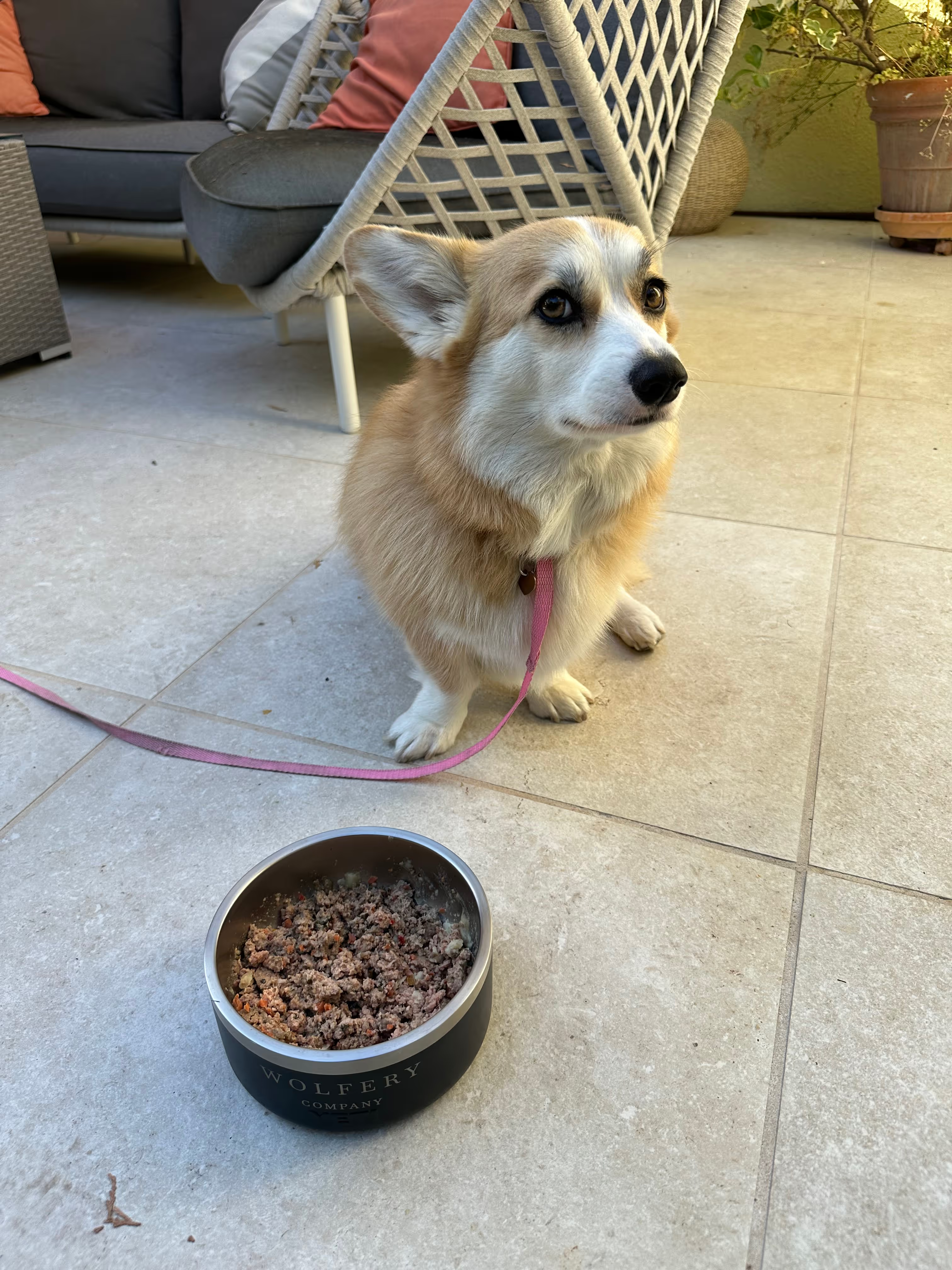
Processing, Contaminants, and the Future of Canine Nutrition
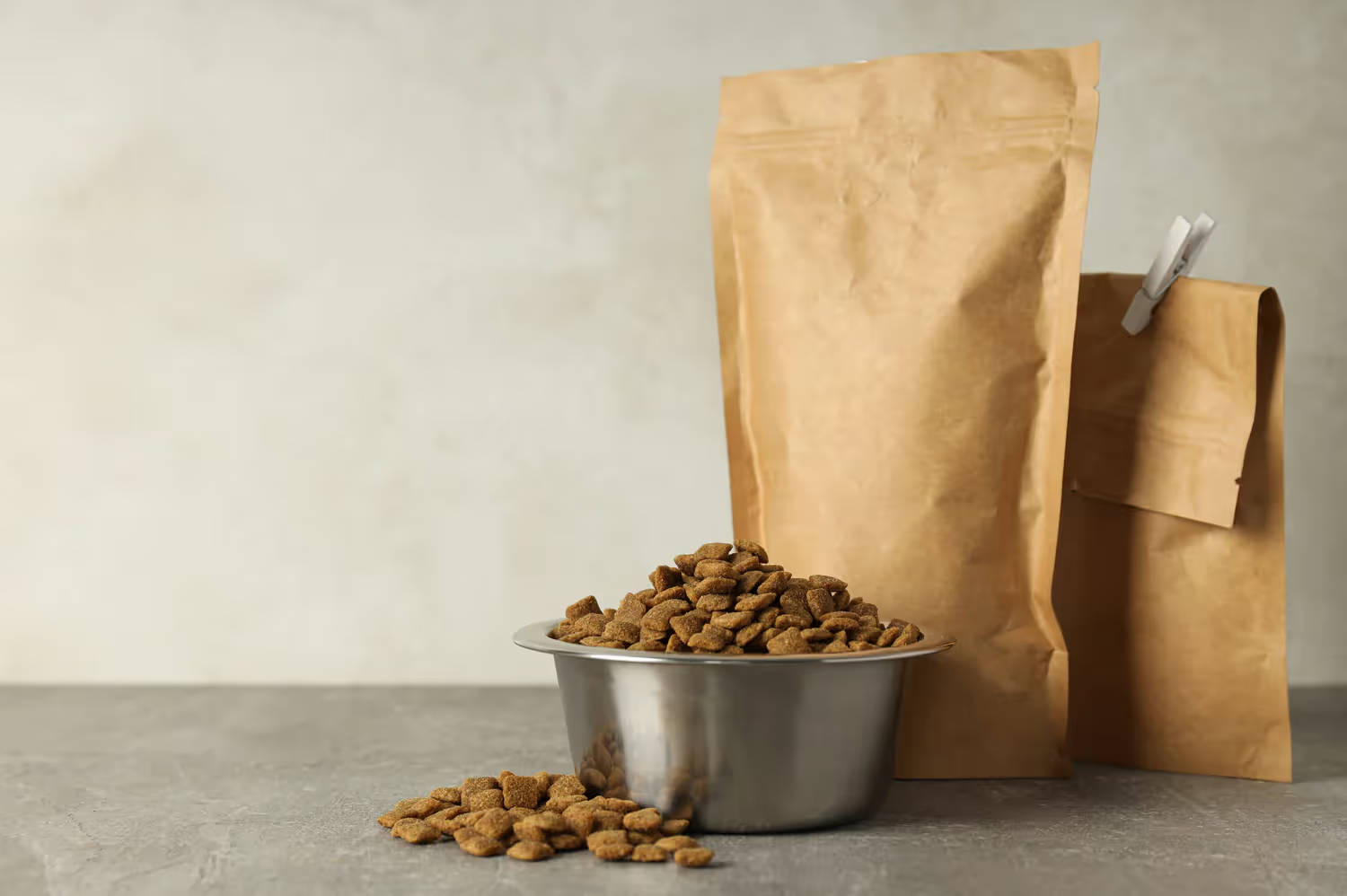

Processing, Contaminants, and the Future of Canine Nutrition
A recent report from CNN has reignited an uncomfortable but necessary conversation about what goes into commercial dog food — and what that means for long-term health.
The article summarized independent testing results and expert commentary suggesting that certain widely available dog foods contain contaminants and processing by-products that raise legitimate concern. While the report does not claim that all commercial dog food is unsafe, it underscores how industrial production systems can introduce risk factors that are often invisible to consumers.
What the CNN Report Highlighted
According to the reporting, testing and expert analysis found:
- Detectable levels of heavy metals in some popular dog food products
- Traces of plastic-related contaminants
- The potential presence of acrylamide, a compound formed during high-heat processing
- Ongoing recall patterns linked to microbial contamination such as Salmonella or Listeria
- Broader questions about how regulatory thresholds are set and enforced
These findings align with recall data and advisories issued over time by the U.S. Food and Drug Administration and regulatory standards established by the Association of American Feed Control Officials.
None of this means that every bag of kibble is inherently dangerous. But it does highlight a systemic issue: the dominant model of pet food is heavily industrialized, and industrialization changes food.
The Processing Problem
Most dry dog food is manufactured using high-temperature extrusion. This method is efficient and scalable, but it subjects ingredients to intense heat and pressure. Nutrients can degrade. Proteins can denature. Certain carbohydrate reactions at high heat can form compounds such as acrylamide.
To meet “complete and balanced” nutrient requirements, manufacturers often add back synthetic vitamins and minerals after processing.
Technically compliant? Yes.
Nutritionally equivalent to minimally processed whole food? That remains debatable.
The issue raised by the CNN report is not just contamination. It is transformation — how many steps occur between raw ingredient and finished product, and what those steps do biologically.
Economics vs. Biology
Kibble dominates because it solves logistical problems:
- Long shelf life
- Cheap transportation
- Bulk storage
- High manufacturing throughput
But convenience and biological alignment are not the same thing.
When cost savings come from extreme processing and commodity inputs, we should ask: who benefits most from that efficiency?
If the economic advantage results in increased long-term inflammatory burden, metabolic strain, or cumulative toxic exposure — even at low levels — then the short-term savings begin to look less persuasive.
Feeding is not a one-time exposure. It is a daily, lifelong intervention.
Why Fresh Food Represents a Structural Shift
Fresh food, when responsibly formulated and handled, alters the equation in several important ways.
It reduces high-heat exposure.
It preserves moisture closer to a dog’s evolutionary diet.
It limits the number of transformation steps.
It minimizes reliance on synthetic reconstruction of nutrients.
This does not mean fresh food is immune to safety standards. It must still meet nutrient adequacy requirements and maintain pathogen controls. But structurally, it introduces fewer industrial stages where contamination or chemical alteration can occur.
Fewer steps mean fewer failure points.
The Ethical Consideration
Some will argue that fresh food is more expensive. That’s true at face value, but this perspective misses a more important calculation: cost per year of healthy life, not cost per bag. If less processed nutrition can reduce the incidence of chronic digestive disorders, inflammation, metabolic stress, and early onset of age-related diseases, then the economic narrative changes. Expense becomes an investment in longevity rather than a one-time purchase.
Adopting a fresh food approach is not about vilifying every processed product; it’s about recognizing all feeding systems are not created equal. There is structural wisdom in minimizing industrial transformation where possible. Fresh food systems naturally constrain the number of failure points — the fewer the steps between raw nutrient and the finished meal, the lower the probability that something goes wrong.
This idea mirrors broader human food trends — a shift away from ultra-processed diets toward whole, minimally altered foods. Humans are increasingly skeptical of food that has been “engineered back together” after destruction. That skepticism, as it turns out, has biological grounding. And it applies to our companions as well. If your priority is not merely to sustain life but to optimize health — to reduce long-term disease risk and support metabolic resilience — then the logic points clearly toward less processed, fresher nutrition.
At its core, caring for a dog means making choices that reflect not just short-term convenience, but long-term wellbeing. Feeding is the most repetitive act of care we perform for a companion animal — more consequential, in many ways, than occasional walks or treats. Each meal accumulates biologically. And when we look beyond marketing claims and regulatory minimums, we see a choice between economies of scale and biology-aligned nutrition.
If your dog’s health is truly the priority, the latter cannot be an afterthought.
Final Thought
Let’s be clear — this is about contaminants. It is about processing methods. And it is about cumulative exposure that compounds quietly over years inside our companions’ bodies.
Marketing language does not change chemistry.
“Complete and balanced.”
“Veterinarian recommended.”
“Scientifically formulated.”
None of those phrases erase the fact that the product is still highly processed.
Processing is not a neutral act. It alters structure. It degrades nutrients. It introduces heat by-products. It increases the number of industrial touchpoints where contaminants can enter. That reality does not disappear because the packaging is reassuring or because a minimum regulatory threshold has been met.
Dogs often eat the same food every single day for a decade or longer. Even when contaminants fall “within allowable limits,” repeated daily exposure becomes the real variable. Biology compounds. And biology keeps score.
Reverse the psychology.
If this were your own body — or your child’s — would you justify a heavily processed diet because it is cheaper and convenient? Would you rely on marketing language to override what you already understand about ultra-processed food? Or would you step back and evaluate the true long-term economics?
Medical bills are not inexpensive. Chronic disease is not a dignified way to live. Prevention is always more rational than correction.
The word “conscious” means deliberate, aware, and intentional. When you choose what goes into your dog’s bowl, that decision should reflect awareness of processing, awareness of cumulative exposure, and awareness of long-term impact — not just price per bag.
If we are going to be conscious about what we put into our own bodies, then we owe that same level of consciousness to the companions who depend entirely on our judgment.
Food compounds. Exposure compounds. Outcomes compound.
Choose consciously.
Further Reading & Research
For readers who want to examine the evidence independently:
- U.S. Food and Drug Administration — Pet Food Recalls & Safety Alerts
https://www.fda.gov/animal-veterinary/news-events/outbreaks-and-advisories - Association of American Feed Control Officials — Nutrient Profiles & Regulatory Standards
https://www.aafco.org - Peer-reviewed study on heavy metals in commercial pet foods
https://www.ncbi.nlm.nih.gov/pmc/articles/PMC8546090/ - Research on combined toxic element exposure risk in pet foods
https://www.nature.com/articles/s41598-025-98066-0 - CDC guidelines on pet food safety and handling
https://www.cdc.gov/healthy-pets/about/pet-food-safety.html