1 in 2. The Number the Pet Food Industry Doesn't Want You to Think About.
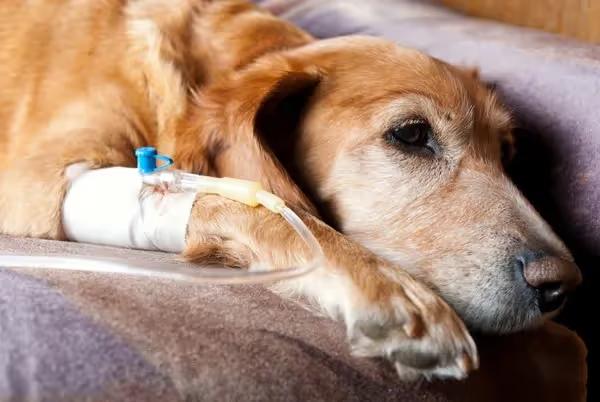

One in four dogs will develop cancer during their lifetime. For dogs over the age of ten, that number rises to one in two.
That's not a fringe statistic. That's the American Veterinary Medical Association.
We are losing our dogs to cancer at a rate that exceeds the human diagnosis rate in this country. And we have collectively decided this is just the way things are.
It isn't.
Cancer doesn't happen in a vacuum. It happens in a body. A body that eats, breathes, rolls in grass, licks its paws, and absorbs whatever environment we've built around it — every single day, for its entire life.
The question worth asking isn't just why our dogs are getting cancer. It's what we've surrounded them with that makes it almost inevitable.
What We're Actually Feeding Them
The commercial pet food industry is a $60 billion business in the United States alone. It is built on one foundational promise: complete and balanced nutrition — verified against a nutritional standard established by the Association of American Feed Control Officials.
The underlying research that standard is built on hasn't been meaningfully updated since 2006. The science informing what goes in your dog's bowl is nearly two decades old.
The bag on the shelf that says "complete and balanced" is telling you the truth — against an aging definition of what complete and balanced actually means.
Extruded dry and wet diets for dogs — commonly known as kibble and canned food — share many features with human ultra-processed foods, which dominate pet diets across developed countries.
We already know what ultra-processed food does to humans. A comprehensive analysis of 45 pooled studies found that greater exposure to ultra-processed foods is associated with a higher risk of type 2 diabetes, cancer, cardiovascular disease, and obesity.
We are now watching the same pattern emerge in dogs.
High-heat processing in kibble produces advanced glycation end-products — AGEs — linked to accelerated aging and chronic disease. A 2026 study measuring serum AGE levels in senior dogs found significantly higher concentrations in those fed extruded kibble compared to dogs eating fresh, minimally processed diets. These elevated AGE levels correlate with increased inflammation, impaired organ function, and shortened lifespans.
University of Helsinki research found that dogs fed non-processed meat-based diets during puppyhood and adolescence had significantly lower rates of chronic disease later in life — while those fed ultra-processed carbohydrate-based diets during the same periods had higher rates.
The food is part of the story. It's not the whole story.
What's on the Lawn
Your dog doesn't walk through the world the way you do.
They move at ground level — nose down, paws on soil, rolling in grass, licking their feet after every walk. Their exposure to the chemical environment around them is fundamentally different from yours. Deeper. More continuous. More intimate.
A 1991 National Cancer Institute study found that dogs whose owners used the herbicide 2,4-D on their lawns four or more times per year were up to twice as likely to develop lymphoma. A 2012 study confirmed the increased risk. Scottish Terriers exposed to herbicide-treated lawns showed cancer rates up to seven times higher than unexposed dogs.
A six-year case-control study at Tufts University found that professional lawn pesticide application was associated with a 70% higher risk of canine malignant lymphoma — one of the most common cancers in dogs, accounting for roughly 20% of all canine cancer diagnoses.
Then came the 2025 research from the University of Wisconsin-Madison, published in Veterinary and Comparative Oncology. Using dogs from the Golden Retriever Lifetime Study, researchers found increased DNA strand breaks in dogs with lymphoma compared to healthy controls. Critically, DNA damage across all dogs was positively correlated with estimated concentrations of both 2,4-D and glyphosate — and oxidative DNA damage was detectable in blood a full year before a lymphoma diagnosis.
The chemical damage precedes the cancer. It's not a consequence. It's a cause.
These findings suggest that environmental chemical exposure may contribute to DNA damage preceding lymphoma — damage that shows up in blood before a diagnosis is ever made.
And herbicides were detectable in the urine of virtually every golden retriever sampled — regardless of whether their own lawn had been treated. Your dog doesn't read the "stay off lawn" flags. They walk on treated grass, roll in it, lick their paws, dig in the soil, and breathe at ground level where chemical concentrations are highest.
The exposure isn't incidental. It's structural. It's in the environment we've built.
What's in the Bowl and on the Ground — At the Same Time
This is the part that doesn't get discussed enough.
Glyphosate — the world's most widely used herbicide — doesn't stay on lawns. In the US, 85% of glyphosate is applied to the nutritional crops that make up 96% of all the plant-based ingredients that pet food manufacturers use: soy, field corn, wheat, rice, dried beans, peas, canola, barley, and potatoes.
Glyphosate is absorbed by plants and is not broken down by cooking or food processing. It persists in plant ingredients and makes its way into pet food.
So your dog is absorbing glyphosate through the food in their bowl and through the ground beneath their paws — simultaneously, continuously, over an entire lifetime.
Glyphosate is a potent chelating agent that binds soil minerals, making them unavailable to plants. It also has strong antibiotic properties — affecting both soil bacteria and the beneficial bacteria in the gut microbiome.
It doesn't just contaminate food. It systematically dismantles the microbial ecosystem that regulates immunity, digestion, and disease resistance.
The same gut that a lifetime of ultra-processed food is already compromising.
These aren't separate problems. They are the same problem arriving from multiple directions at once — in the bowl, on the ground, in the soil, in the rain.
Why the Industry Doesn't Change
The answer is the same in pet food as it is in every industry that has resisted reform: the infrastructure is too valuable to abandon.
Extrusion facilities. Global grain supply chains. Spray-drying operations. Chemical preservation systems. These are billion-dollar physical investments built around one product format — shelf-stable, ultra-processed kibble — that becomes significantly less defensible the moment the science is taken seriously.
So the marketing runs faster than the science. "Complete and balanced." "Veterinarian recommended." "All life stages." Language calibrated to satisfy a regulatory floor while signaling something far more than that.
Fresh dog food dollar sales have risen 86% since 2021. The fresh pet food market is projected to grow at nearly 30% compound annual growth through 2028 — outpacing overall dog food growth by a factor of six.
That growth isn't a trend. It's a correction.
Pet owners are making the connection that took human consumers a generation to make: the food you put in an animal's body every single day, for its entire life, is not neutral. It accumulates. It either builds health or it quietly erodes it.
What Actually Changes the Outcome
The same discipline that defines how a Michelin kitchen operates — traceability, precision, respect for the ingredient — is the standard dog food should have been held to from the beginning.
Real proteins. Whole vegetables. Ingredients you can trace and pronounce. No chemical preservatives designed to extend shelf life at the expense of biological health. Portions calibrated to the specific animal eating them — their weight, their breed, their actual activity level on that specific day — not averaged against a population and rounded to the nearest cup.
That's not a luxury position. It's the baseline that was always owed.
Every ingredient at The Wolfery is chosen with one question: would I cook this in a Michelin kitchen? Can I trace where it came from? Do I know what was — and wasn't — done to it before it arrived?
We calculate every portion against what that specific dog actually needs. We integrate real activity data. We don't use preservatives that require decades-old regulatory classifications to justify their presence. We don't optimize for shelf life.
We optimize for the animal eating the food.
One in two dogs over ten will develop cancer. That number is not acceptable. It is not inevitable. And it will not change until the bowl changes — and until we start paying attention to everything else we've surrounded our dogs with too.
SOURCES & CITATIONS
AVMA — American Veterinary Medical Association, canine cancer prevalence.
Frontiers in Veterinary Science (2026) — AGE levels in senior dogs, kibble vs. fresh diet.
University of Helsinki DogRisk Project — diet and chronic disease in dogs, longitudinal study.
National Cancer Institute (1991) — 2,4-D herbicide and canine lymphoma.
Environmental Research / Tufts University (2012) — lawn pesticide application and canine lymphoma risk.
Veterinary and Comparative Oncology / University of Wisconsin-Madison (2025) — Golden Retriever Lifetime Study, glyphosate, 2,4-D, DNA damage preceding lymphoma.
Lane et al., BMJ (2024) — 45-study meta-analysis, ultra-processed food and chronic disease.
Euromonitor / Dogster (2026) — fresh pet food market growth projections.